DTSA supports RICS at UKREiiF


"I have learnt to love rejection, EVERY setback will lead to an amazing comeback!"
_ Dr Abolade 'Bola' Abisogun OBE
(RICS Digital Champion)
For the Royal Institution of Chartered Surveyors ‘RICS’ the 9th March 2026 is almost as significant as the day that the RICS began its operations, following a meeting by its founding members that took place on the 15th June 1868. Now, almost 159 years later, the current day matrix of structural, ethical and operation challenge, comprehensively represents a paradigm shift, given the evolution of the ‘global’ Surveying profession; a shift that fundamentally, changes everything and affects everyone, including commissioning clients and the public at large.

Credit: RICS
Inspired by an approach from the previous Senior Leadership team of that time, the theme of our contribution via our Founder & President, commands that (today) we take a look at our own journey and refer specifically to an RICS report that Dr Bola contributed towards back in 2018/2019.
But before that, let's take a trip down 'memory lane' ..........

Credit: Dr Bola Abisogun OBE, FRICS

Credit: Dr Bola Abisogun OBE, FRICS
“My introduction to the Surveying profession (during 1992/93) was riddled with voluminous rejection; it was so demoralising. And, despite aligning myself on the advice of my tutoring staff at the University, to supporting the RICS as early as July 1994 when I graduated, I also assumed that by ‘successfully’ concluding research in an area (back then) which, spoke of ‘artificial neural networks (ANN’s) and hypertext expert systems’ - that I’d be uniquely positioned to capitalise on several employment opportunities. What on earth was I thinking(?), not much has changed in the professions own and wider sectoral approach towards the pursuit of innovation; however, today (in May 2026) the future has never been brighter for the 'serial' and unapologetic, industry disruptor” _ Dr Bola Abisogun OBE FRICS

Credit: Dr Bola Abisogun OBE, FRICS

Credit: Dr Bola Abisogun OBE, FRICS

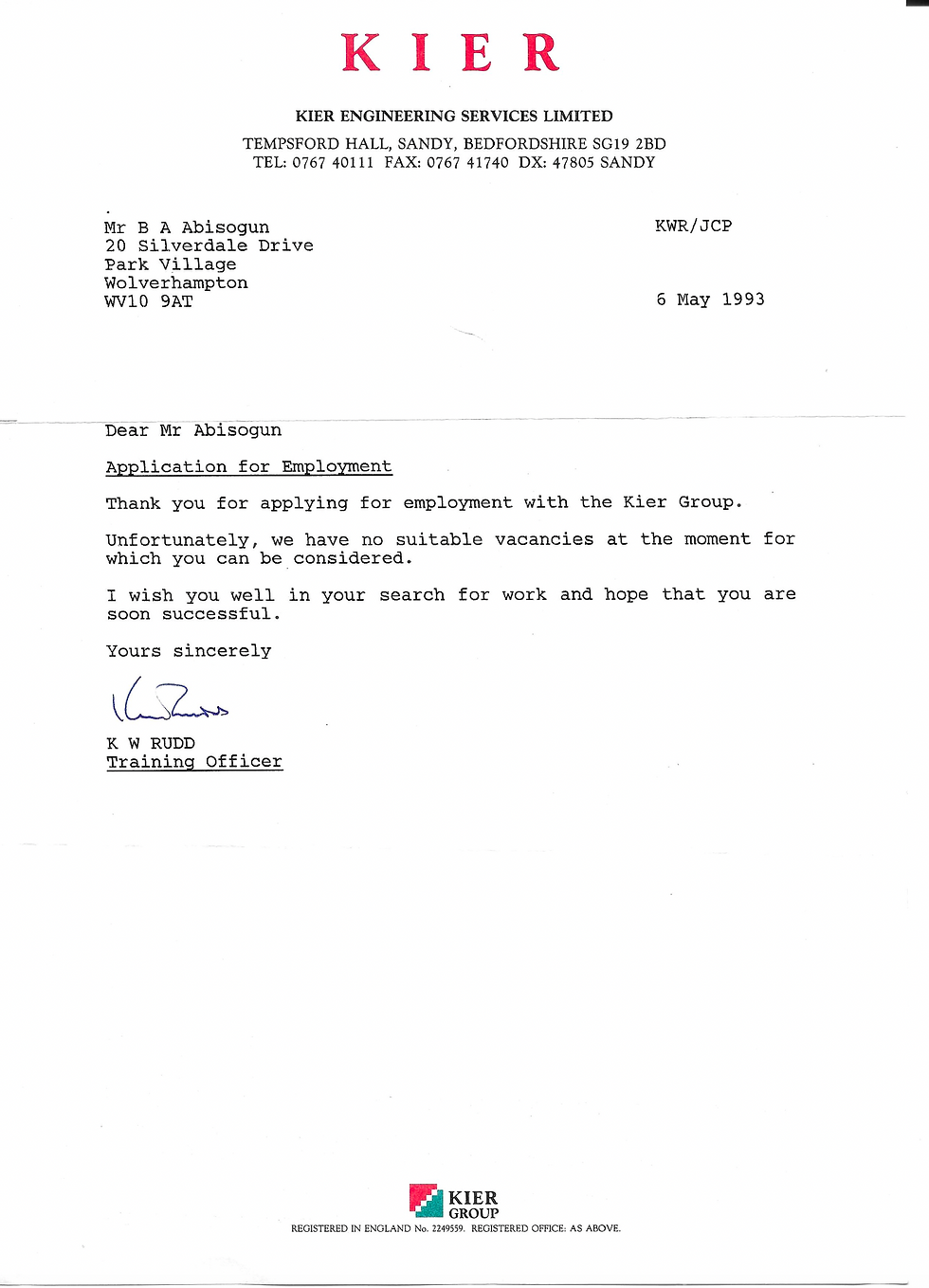
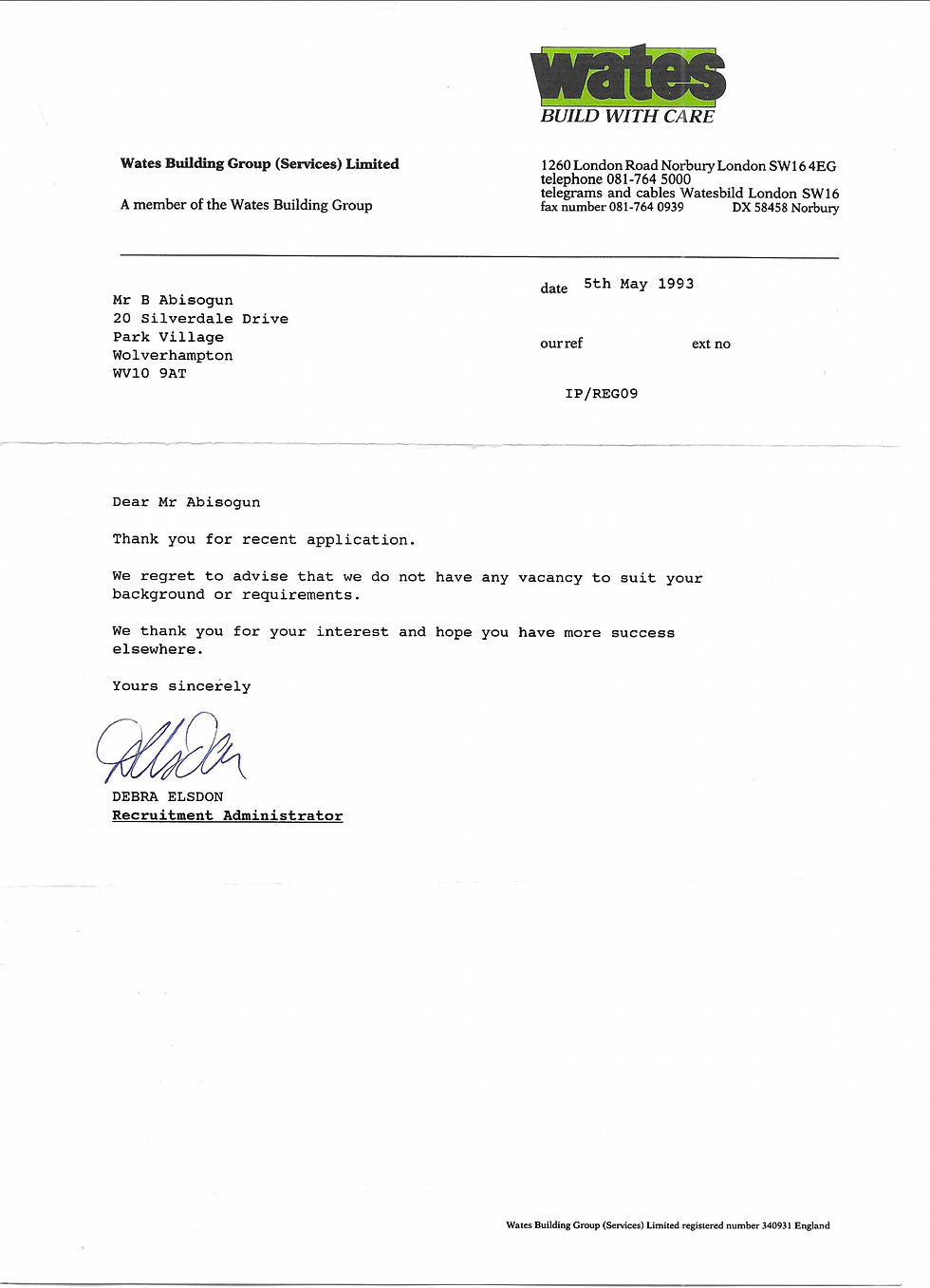
Based upon his work completed at the University of Cambridge _ it's time to re-evaluate what the 'future-skillset' of the #Surveyor will need to look like and comprise ............ and In this window of structural, operational and procedural transition, continuous rejection will become completely normal ............ here are just some of the written responses, that were received by our Founder, prior to his graduation, in 1994 ........

Credit: Dr Bola Abisogun OBE, FRICS
Back in the 90's and despite being armed with knowledge, optimism and a hunger to succeed, our Founder embarked on a journey of cumulative rejection _ again ..........

Credit: Dr Bola Abisogun OBE, FRICS
and again ...............

Credit: Dr Bola Abisogun OBE, FRICS
and again ...............

Credit: Dr Bola Abisogun OBE, FRICS
and again ...............

redit: Dr Bola Abisogun OBE, FRICS
and again ...............

Credit: Dr Bola Abisogun OBE, FRICS
and again ...............

Credit: Dr Bola Abisogun OBE, FRICS
and again ...............

Credit: Dr Bola Abisogun OBE, FRICS
and again ..............

Credit: Dr Bola Abisogun OBE, FRICS
and again ...............
Credit: Dr Bola Abisogun OBE, FRICS
and again ...............

Credit: Dr Bola Abisogun OBE, FRICS
and again ...............

Credit: Dr Bola Abisogun OBE, FRICS
and again ...............

Credit: Dr Bola Abisogun OBE, FRICS
and again ...............

Credit: Dr Bola Abisogun OBE, FRICS
and again ...............

Credit: Dr Bola Abisogun OBE, FRICS
and again ...............

Credit: Dr Bola Abisogun OBE, FRICS
and again ...............

Credit: Dr Bola Abisogun OBE, FRICS
and again ...............

Credit: Dr Bola Abisogun OBE, FRICS
and again ...............

Credit: Dr Bola Abisogun OBE, FRICS
and again ...............

Credit: Dr Bola Abisogun OBE, FRICS
and again ...............

Credit: Dr Bola Abisogun OBE, FRICS
and again ...............

Credit: Dr Bola Abisogun OBE, FRICS
and, still the rejections came ...............

Credit: Dr Bola Abisogun OBE, FRICS
and again ...............

Credit: Dr Bola Abisogun OBE, FRICS
and again ...............
Credit: Dr Bola Abisogun OBE, FRICS
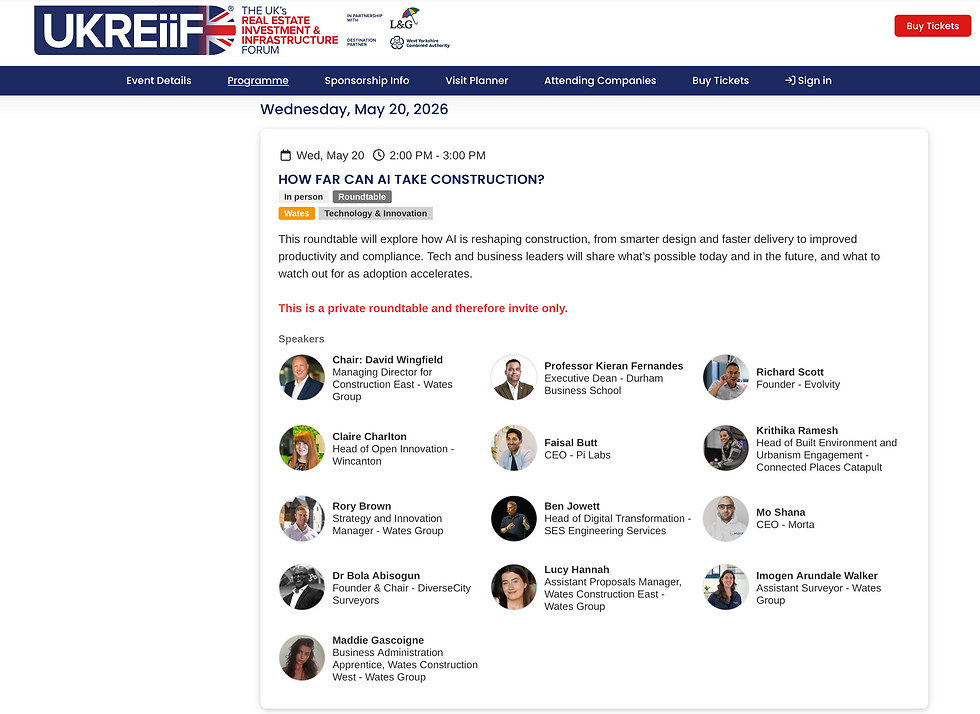
until finally (during 1Q2026) .......... Dr Bola was approached and invited by Wates, to talk about AI in Construction (taking him back, full circle to his thesis of 1993/94); this is a true testament to the 'patience, agility & resilience' of our Founder, despite his journey. Given the well documented push-back and rejection, endured most of his career .............. it is worth noting that similar lived experiences, will become the reality for many, if AI is not willingly embraced, at a person-centric level ...........
Credit: Wates / UKREiiF (May 2026)


Credit: RICS
Kindly invited by RICS to contribute to a panel discussion on the future of the Surveying profession ................. Ellie, Grainne, Harry and Kay are truly amazing!

The RICS "Future of the Profession" initiative focuses on transforming surveying to be sustainable, data-driven, and intentionally client-focused (now infused by AI) by 2026. Key trends include AI, IoT, and digital transformation, driving a shift towards professional judgment in a more decentralized, decarbonized, and technologically advanced built environment.
Key elements of the RICS future strategy included:
• Technology & Data: The profession is shifting to rely on AI and IoT, requiring professionals to act as trusted advisors interpreting data, rather than just producing it.
• Sustainability & ESG: The Surveying skills report 2025 highlights sustainability and decarbonization (affirmed by 41% of respondents) as a top priority, with new pathways for residential retrofit and ESG.
• Skills & Education: The Future of the profession report highlights that professionals need to bridge the skills gap, with 59% of respondents prioritizing advanced digital tools and data analytics.
• Future Foundations Strategy: RICS aims to strengthen the profession by ensuring high standards, promoting diversity, and providing a 365-day virtual content hub for professional development.
• Defining our Future: An ongoing review ensuring RICS governance, standards, and strategic directions are aligned with the evolving needs of members and society.
• The profession back then, and still is, heavily focused on addressing the ‘multi-faceted’ skills gap (as highlighted by 87% of practitioners) through tailored training and fostering a more diverse talent pool.
Credit: Dr Bola Abisogun OBE, FRICS
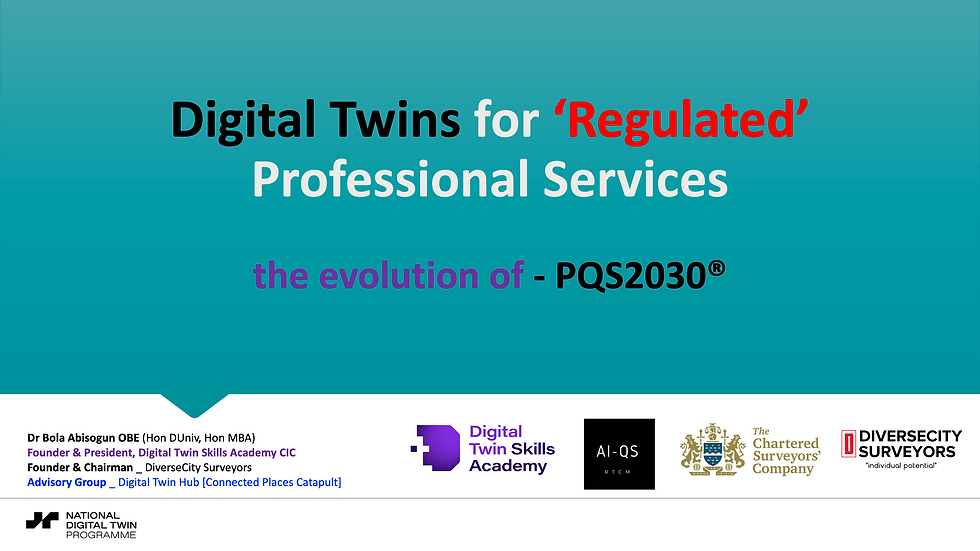
We would now refer you to aforementioned 2019 report titled where this document sought to examine how the surveying profession is evolving in response to rapid technological advances, urbanisation, and shifting business models. The report drew upon well over a thousand conversations with members and surveying professionals, in order to assess readiness for the future, while outlining how RICS cultivated plans to lead the profession through an emerging landscape of profound change.

Credit: RICS
Looking at the January 2019 report the document examines how the surveying profession is evolving in response to rapid technological advances, urbanisation, and shifting business models. It draws upon over a thousand conversations with professionals to assess readiness for the future and outlines how RICS plans to lead the profession through these changes.

Credit: Dan Hughes / AlphaProp Insight
A central theme is the explosion of data and the integration of technologies like artificial intelligence and the internet of things. The report highlights that the profession must manage the quality, ownership, and privacy of data carefully. It states, “A world of AI relies on and revolves around well collected, cleansed and managed data.” Surveyors are urged to protect their data to maintain relevance and client confidentiality in a digital marketplace.

Business models are also transforming. Traditional approaches focused on physical assets and billable time are giving way to customer-centric and decentralized models. The report cites WeWork’s rapid expansion, building out two million square feet monthly worldwide, as an example of new real estate typologies reshaping the market. It notes that real estate is shifting from business-to-business to business-to-consumer, emphasising the lifetime value of customers rather than just property transactions.

The report stresses the need for evolving skills and education. Seventy-five percent of respondents agree that training for future professionals must change. Lifelong learning, digital skills, and emotional intelligence are key. The document says, “We need to learn how to use PropTech,” and that “the human element is still where the value is,” underscoring the continued importance of professional judgment alongside technology.

Urbanisation and sustainability are urgent challenges. The UN projects that by 2050, about 6.5 billion people—two thirds of the global population—will live in cities. The profession must address climate change and resource scarcity, driving “a quantum shift in the environmental impact of the built environment” to ensure sustainable development.

Major Drivers of Change
• Data and Technology:
• Effective understanding and use of data is now critical. Data quality, ownership, and management are central issues.
• Artificial intelligence (AI), the Internet of Things (IoT), and big data are transforming the sector, offering both opportunities (efficiency, predictive maintenance, better asset management) and risks (privacy, cybersecurity).
• The convergence of the built environment and technology sectors is accelerating, requiring new skills and business models.
• Changing Business Models:
• Traditional models are shifting towards output/value-based approaches, decentralization (e.g., blockchain, trust platforms), and customer-centricity.
• Real estate is moving from B2B to B2C, with a focus on customer experience and asset lifecycle management.
• Urbanization and Sustainability:
• Rapid urbanization and climate change are pressing challenges. The profession must drive sustainable development and resource efficiency.

Evolving Professional Skills and Roles
• Lifelong learning, adaptability, and digital proficiency are increasingly important.
• Non-technical skills (emotional intelligence, creativity, collaboration) remain vital, as technology cannot replace human judgment and ethical standards.
• The profession is moving up the value chain, with advisory and creative roles becoming more prominent as routine tasks are automated.

In response, RICS is updating standards, promoting diversity, revising accreditation and continuing professional development programs, and encouraging cross-disciplinary collaboration. Starting in May 2019, the Governing Council will lead a 12-month strategic Futures review to guide the profession’s adaptation. The report emphasizes maintaining “ethical and technical judgement” and preparing to regulate automated systems as technology advances
Quantitative Research Findings
• 66% of respondents foresee changing business models impacting their roles in the future.
• 83% report that technology is already impacting their roles (49% moderately, 34% significantly).
• Only 36% say their organizations are making the most of available technology; 47% have a digital strategy.
• 75% believe the next generation of professionals needs different training; 78% are confident the sector can attract the right talent.

RICS Response and Recommendations (in 2019)
• Diversity and Entry Barriers:
• Widen access to the profession, promote non-traditional education routes, and increase diversity.
• Accreditation and Qualifications:
• Update accreditation and competencies to reflect technological and market changes, including ethics, data, and AI.
• Continuous Professional Development (CPD):
• Revise CPD to ensure ongoing relevance, cross-train with other professions, and support learning at all career stages.
• Technology Integration:
• Make technology central to training and professional development; encourage innovation and test-bed approaches.
• Collaboration:
• Foster interdisciplinary collaboration within and beyond the sector.
• Standards and Regulation:
• Anticipating Change:
• Promote agility, trend awareness, and proactive engagement with future challenges.

Conclusion
• The profession faces significant change but has core strengths—professionalism, technical expertise, ethical judgment—that will enable it to adapt and lead.
• RICS commits to ongoing strategic review and sector leadership, encouraging broad engagement and debate on the future direction.

Credit: RICS
Example Implementation:
• Organizations should review their digital strategies, invest in staff training for both technical and non-technical skills, and participate in RICS-led initiatives for collaboration and standard-setting.
• Individuals should pursue lifelong learning, embrace new technologies, and develop both technical and soft skills to remain competitive.
This summary provides a concise yet comprehensive overview of the report's key findings and recommendations, supporting informed decision-making and strategic planning.
The report set the stage for the profession to navigate a data-driven, technology-enabled future while upholding the core values that have defined surveying for 159 years.

Enveloped by the new professional standard on the use of AI, launched on 9th March 2026
· To provide confidence to people that AI and data can be adopted ethically and responsibly to help your business
· To highlight practical case studies where use of AI is driving business innovation
· To show how it is different for small or large firms – challenges/opportunities
· To promote the RICS standard on AI and new pathway as an industry leading document that is providing a practical framework to accelerate AI adoption responsibly
· To promote RICS as a profession for the data/tech industry with a new pathway
Join us in Leeds at UKREiiF _ and take part in the conversation, it's all taking place in the RICS Studio ……. we'll see you there!!


This is a fantastic overview of the surveying profession’s evolution! As we navigate this era of rapid technological change and digital transformation, effective engagement is more critical than ever. Implementing the LEAPS Model of Communication—Listen, Empathize, Ask, Paraphrase, and Summarize—will be essential for professionals to bridge the current skills gap, foster collaboration, and truly lead in our increasingly complex landscape.